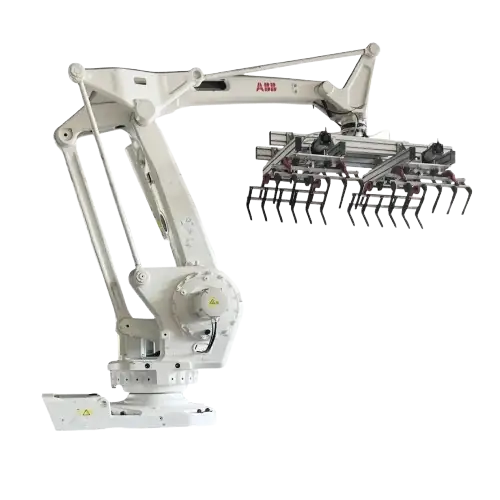
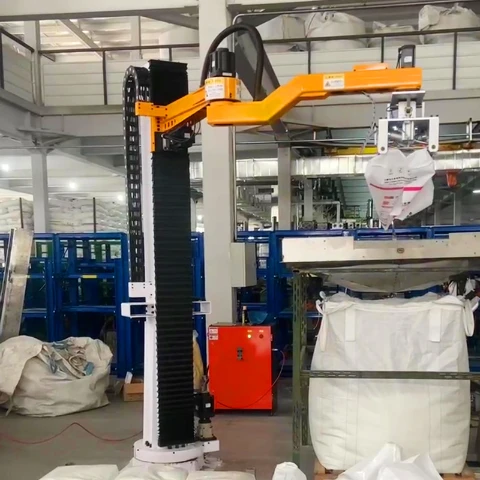
Robotic Arm Palletiser left side

Introduction

Handling bulk bags manually is time-consuming, inconsistent, and difficult to scale. Modern manufacturing facilities are increasingly adopting robotic arm debagging machines to automate bag handling, cutting, and product discharge with precision and repeatability.

In this article, we explain how a robotic arm debagging machine works, step by step, and why it has become a preferred solution for automated material handling across multiple industries.

What Is a Robotic Arm Debagging Machine?

A robotic arm debagging machine is an automated system designed to pick bags from pallets, open them using a blade, and discharge the contents into a hopper for downstream processing.

Unlike traditional fixed-position automation, robotic debagging systems use:

  • 3D vision and visual recognition

  • Adaptive robotic motion

  • Gripper-based bag handling

  • Blade and hopper integration

This allows the system to handle variations in bag size, pallet layout, and stacking orientation.

Step-by-Step Robotic Debagging Process

1. Pallet Delivery and Positioning

Full pallets of PE or PP bags are delivered to the debagging area using a forklift or pallet conveyor.
The pallet is positioned within the robot’s working envelope.


2. Visual Recognition and Bag Detection

Vision cameras scan the pallet to identify:

  • Individual bag positions

  • Orientation and height

  • Pallet configuration

The system automatically recognises different pallet sizes and bag layouts without manual reprogramming.


3. Robotic Arm Targeting

Using the visual data, the robotic arm calculates the optimal pick position and movement path.
This ensures accurate targeting even when bags are unevenly stacked.


4. Gripper-Based Bag Handling

The robotic arm moves to the target bag and grips it using an industrial gripper designed for PE and PP packaging.


5. Transfer to the Debagging Blade

The robot transports the bag along a predefined path and positions it over the debagging blade.


6. Bag Opening and Product Discharge

The blade opens the bag, allowing the material to discharge directly into the hopper below.
The hopper feeds the material into the next stage of the production process.


7. Continuous Operation

After completing the cycle, the robot returns to scanning mode and repeats the process for the next bag, automatically adjusting for:

  • Bag size variation

  • Orientation changes

  • Different pallet layouts


Why Automated Robotic Debagging Improves Production

Robotic arm debagging machines provide:

  • Consistent and repeatable operation

  • Reduced reliance on manual handling

  • Continuous, predictable material flow

  • Improved process stability

This makes them ideal for high-throughput industrial environments.

Conclusion

Understanding how a robotic arm debagging machine works highlights why it has become a critical component in modern automated production lines. By combining vision technology, robotic precision, and intelligent control, manufacturers can achieve reliable, scalable debagging operations.

Featured Thinking

What Is a Column Robot Debagging Machine? Working Principle, Benefits & Applications