Blog
The Dusty Challenge of Cement Bagging
The cement industry faces one of the toughest packaging environments in manufacturing — abrasive dust, high temperatures, and continuous throughput demands. Manual valve bag placement in cement bagging plants is not only inefficient but also hazardous for operators.
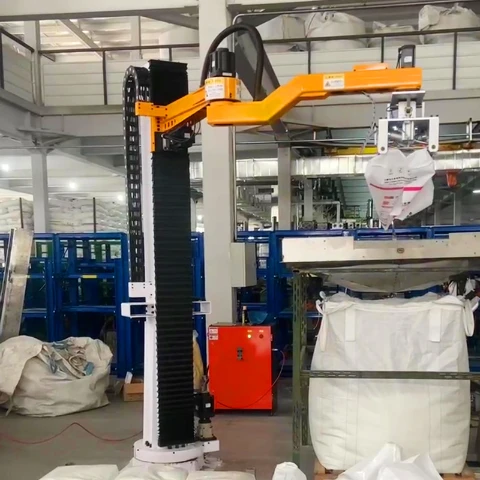
The solution? Automatic bagging for the cement industry — using a robotic valve bag placer that eliminates manual bag hanging and ensures each valve bag is perfectly placed for filling, every time.
How Automatic Bagging Works in a Cement Plant
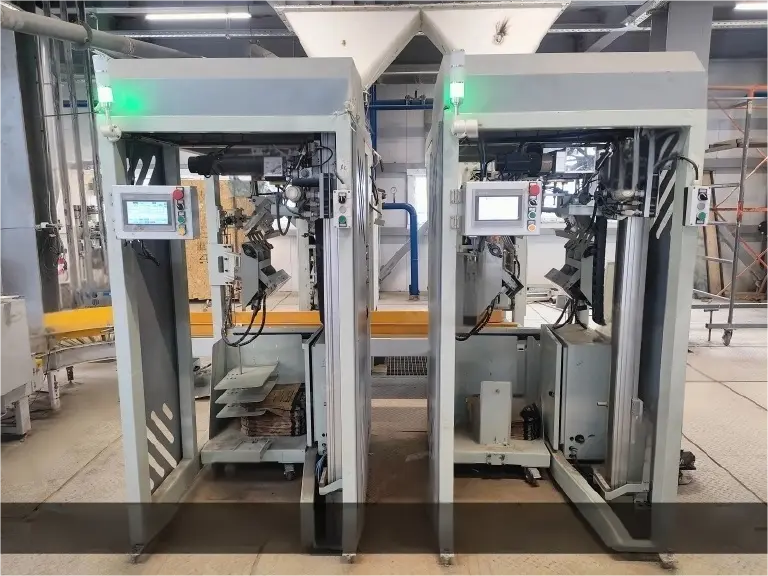
An Automatic Bag Placer integrates directly with the valve bag filling machine on the production line.
Process Overview:
-
Bag Magazine Feed: Pre-stacked valve bags (paper or PE) are loaded into the bag magazine.
-
Robotic Pick & Pre-Open: The robotic placer picks one bag at a time, opens the valve using air or mechanical fingers.
-
Precision Spout Alignment: Sensors guide the bag mouth to the filling spout.
-
Placement & Release: The valve bag is securely placed, ready for automatic filling.
-
Continuous Filling: As one bag is filled, the next is already being positioned — ensuring zero downtime.
This synchronized process enables smooth, continuous production — ideal for 24/7 cement operations.
Application-Specific Benefits
| Benefit | Cement Industry Impact |
|---|---|
| Dust Reduction | Eliminates manual handling of dry cement near spouts, minimizing airborne particles. |
| Operator Safety | Reduces exposure to silica dust and repetitive strain injuries. |
| Throughput Increase | Speeds up bag changeovers; enables dual-robot setups reaching 40 bags/min. |
| Bag Consistency | Each valve bag is perfectly placed, reducing spillage and sealing issues. |
| ROI & Maintenance | Typical ROI within 12–18 months; low maintenance mechanical system. |
Case Study: Automating Cement Bag Placement
Client: Major cement manufacturer, South Asia
Setup: 4-spout valve bag filling line
Problem: Manual bag hanging caused inconsistent feed and frequent stoppages.
Solution: Installed a Robotic Valve Bag Placer integrated with their existing packing machine.
Results:
-
+48% increase in bagging capacity
-
Zero operator exposure to dust
-
Reduced downtime by 35%
-
ROI achieved in 15 months
“We were able to redeploy our operators to safer, higher-value tasks while maintaining a continuous filling rate — something we couldn’t achieve before automation.”
— Production Manager, Cement Plant Client
Why Cement Producers Are Switching to Robotic Bag Placers
Cement packaging plants are under increasing pressure to reduce dust emissions, energy usage, and manual labor costs.
Automating the bag placement process not only meets these goals but also future-proofs operations for integration.
By combining PLC control, servo-driven actuators, and bag detection, today’s systems offer unmatched reliability — even in harsh environments.

Conclusion
Automatic bagging systems are redefining how cement producers operate — increasing output, improving safety, and ensuring cleaner working environments.
By integrating a Robotic Valve Bag Placer, cement manufacturers can achieve faster, safer, and more sustainable packaging operations — one valve bag at a time.
Featured Thinking
Blog Request a quotation Find out More How a Column Robot Debagging Machine Works The Column Robot Debagging Machine automates the entire bag emptying process using robotic precision and intelligent control systems. This system is designed to handle 25kg and 50kg bags efficiently while maintaining a clean and controlled working environment. Watch the full […]
Blog Request a quotation Find out More Automatic Bag Emptying Machine for 25kg & 50kg Bags Handling heavy industrial bags manually is inefficient, unsafe, and inconsistent. The Column Robot Debagging Machine solves this by automating the bag emptying process for 25kg and 50kg bags. This automatic bag emptying machine is designed for high-performance industrial environments […]