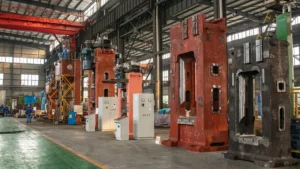
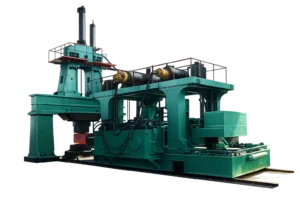
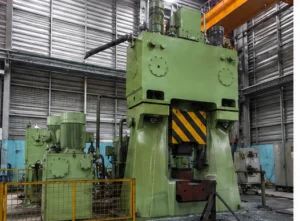
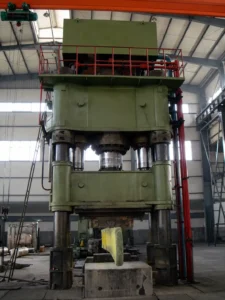
An electric screw press uses an electric drive and screw mechanism to generate controlled forming energy for forging. It is widely used in hot forging, closed die forging, precision forging, sizing, coining and calibration processes.
The basic working process begins when the electric drive system accelerates the moving components and transfers energy through the screw mechanism. The ram or slide moves downward, applying forming force to the heated billet inside the die. The workpiece is shaped by the pressure and impact created during the forging stroke.
One of the key advantages of the electric screw press is that the striking energy can be controlled according to the forging requirement. This means the machine can be adjusted for different materials, billet sizes, die designs and forming stages. For example, aluminium alloy forging may require a different energy setting from steel forging or brass forging.
After the forging stroke, the slide returns to the preset position, allowing the operator or automation system to continue the next step. In a complete forging line, the process may include billet cutting, induction heating, loading, forging, trimming and cooling.
The electric screw press is different from a mechanical press because it does not rely on a fixed bottom dead centre in the same way. It is also different from a power hammer because it is usually selected for more controlled closed die forging and precision forming applications.
This makes the machine useful for manufacturers producing automotive parts, machinery components, hand tools, hardware, brass fittings, aluminium alloy components and other forged metal parts.
For buyers, the most important technical factors include press capacity, energy, stroke, table size, die space, frame rigidity, drive system and automation compatibility.